
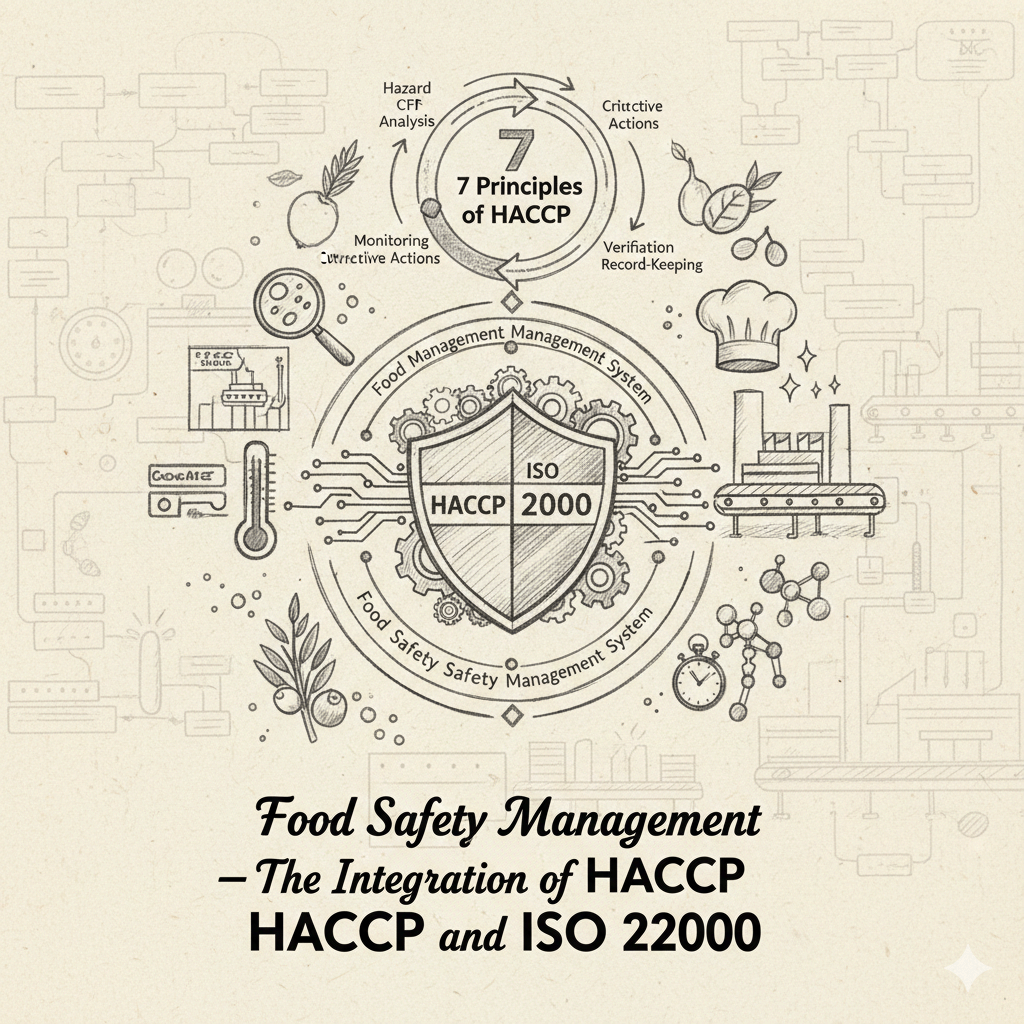
- Introduction: The Science of “Farm to Fork” Safety
In the globalized food supply chain, safety is a non-negotiable prerequisite for market entry. At ISOSAF, we approach food safety through a rigorous scientific lens, combining the preventative principles of HACCP (Hazard Analysis and Critical Control Points) with the management structure of ISO 22000:2018. This dual approach ensures that biological, chemical, and physical hazards are not merely monitored but systematically eliminated. As food-borne illnesses remain a significant global health risk, these standards provide the legal and technical safeguards necessary for consumer protection.
- The Legal Evolution of Food Safety Standards
The legal landscape for food safety has shifted from reactive inspection to proactive prevention.
- Codex Alimentarius: Developed by the FAO and WHO, the Codex provides the international legal foundation for food standards. It is the reference point for the WTO in trade disputes.
- FSMA (Food Safety Modernization Act): In the United States, this law requires facilities to implement written preventive controls.
- EU General Food Law (Regulation 178/2002): This regulation establishes the “precautionary principle” and mandates traceability at all stages of production and distribution.
- The Scientific Core: The Seven Principles of HACCP
HACCP is a systematic, science-based approach to identifying and controlling hazards.
- Hazard Analysis: Scientifically identifying potential biological (e.g., Salmonella), chemical (e.g., mycotoxins), or physical (e.g., glass shards) risks.
- Determine Critical Control Points (CCPs): Identifying stages in the process where control can be applied to prevent or eliminate a hazard (e.g., a specific cooking temperature).
- Establish Critical Limits: Defining the scientific boundaries for safety (e.g., internal temperature must reach 75°C).
- Monitoring Procedures: Implementing real-time checks to ensure limits are met.
- Corrective Actions: Predetermined steps taken when a CCP is not under control.
- Verification: Scientifically proving the system works (e.g., testing the final product or reviewing records).
- Record-Keeping: Providing the legal “audit trail” of safety compliance.
- ISO 22000:2018 – The Management Framework
While HACCP focuses on the technical control of hazards, ISO 22000 provides the broader management system. It follows the High-Level Structure (Annex SL), making it compatible with ISO 9001 and ISO 14001.
- Interactive Communication: Ensuring information flows throughout the supply chain (suppliers, customers, and regulators).
- Prerequisite Programs (PRPs): The fundamental conditions and activities necessary to maintain a hygienic environment (e.g., pest control, personal hygiene).
- OPRPs (Operational Prerequisite Programs): Specific controls identified by hazard analysis as essential but not quite CCPs.
- Traceability and Recall Management: The Legal Safety Net
From a legal standpoint, the ability to execute a rapid recall is paramount. ISO 22000 mandates a traceability system that can identify a product’s history “one step back and one step forward.”
- Scientific Validation: Traceability is validated through “mock recalls,” where an organization must account for 100% of a batch within a specific timeframe (often 4 hours).
- Legal Liability: Failure to maintain traceability can lead to criminal negligence charges in several jurisdictions if contaminated food reaches the public.
- Food Fraud and Food Defense (TACCP & VACCP)
Modern food safety now includes the prevention of intentional harm.
- TACCP (Threat Assessment Critical Control Point): Focusing on preventing malicious contamination (Food Defense).
- VACCP (Vulnerability Assessment Critical Control Point): Focusing on preventing economically motivated adulteration, such as replacing premium ingredients with cheaper substitutes (Food Fraud).
[Image comparing HACCP, TACCP, and VACCP focus areas]
- Global Trade and GFSI Recognition
The Global Food Safety Initiative (GFSI) is an industry-driven initiative that benchmarks various food safety standards. While ISO 22000 is a standalone standard, the FSSC 22000 (which combines ISO 22000 with specific technical sector prerequisites) is GFSI-recognized. For exporters in Vietnam or China, GFSI recognition is often a mandatory requirement to supply global retailers like Walmart or Carrefour.
- The ISOSAF “Observation to Assessment” Workflow
At ISOSAF, under the technical direction of Dr. Tan Wei Ming, we utilize the “Observation” pillar to monitor emerging food pathogens and chemical risks. This data feeds into the “Assessment” phase, where we audit facilities against ISO 22000 and HACCP. Our goal is to ensure that “Frontier Development” in food technology—such as plant-based proteins or lab-grown meat—adheres to the same rigorous safety standards as traditional food production.
- Conclusion: Safety as a Foundation for Growth
Food safety management is a continuous scientific journey. By integrating HACCP’s technical precision with ISO 22000’s management rigor, organizations can protect their consumers, their brand, and their legal standing. As we move toward more complex global food systems, these standards remain the essential “Kim chỉ nam” (Compass) for any enterprise aiming for global excellence.
- References and Reliable Sources
- ISO (2018). ISO 22000:2018 Food safety management systems — Requirements for any organization in the food chain.
- Codex Alimentarius. (2020). General Principles of Food Hygiene (CXC 1-1969).
- Wallace, C. A., Sperber, W. H., & Mortimore, S. E. (2018). Food Safety Management: A Practical Guide for the Food Industry. Academic Press.
- World Health Organization (WHO). Food Safety Fact Sheets and Global Burden of Foodborne Diseases.
- Global Food Safety Initiative (GFSI). Benchmarking Requirements for Food Safety Management Systems.
- Lawley, R., Curtis, L., & Davis, J. (2012). The Food Safety Hazard Guidebook. Royal Society of Chemistry.
- ISOSAF Technical Report. Emerging Pathogens and the Evolution of HACCP in Southeast Asia.