
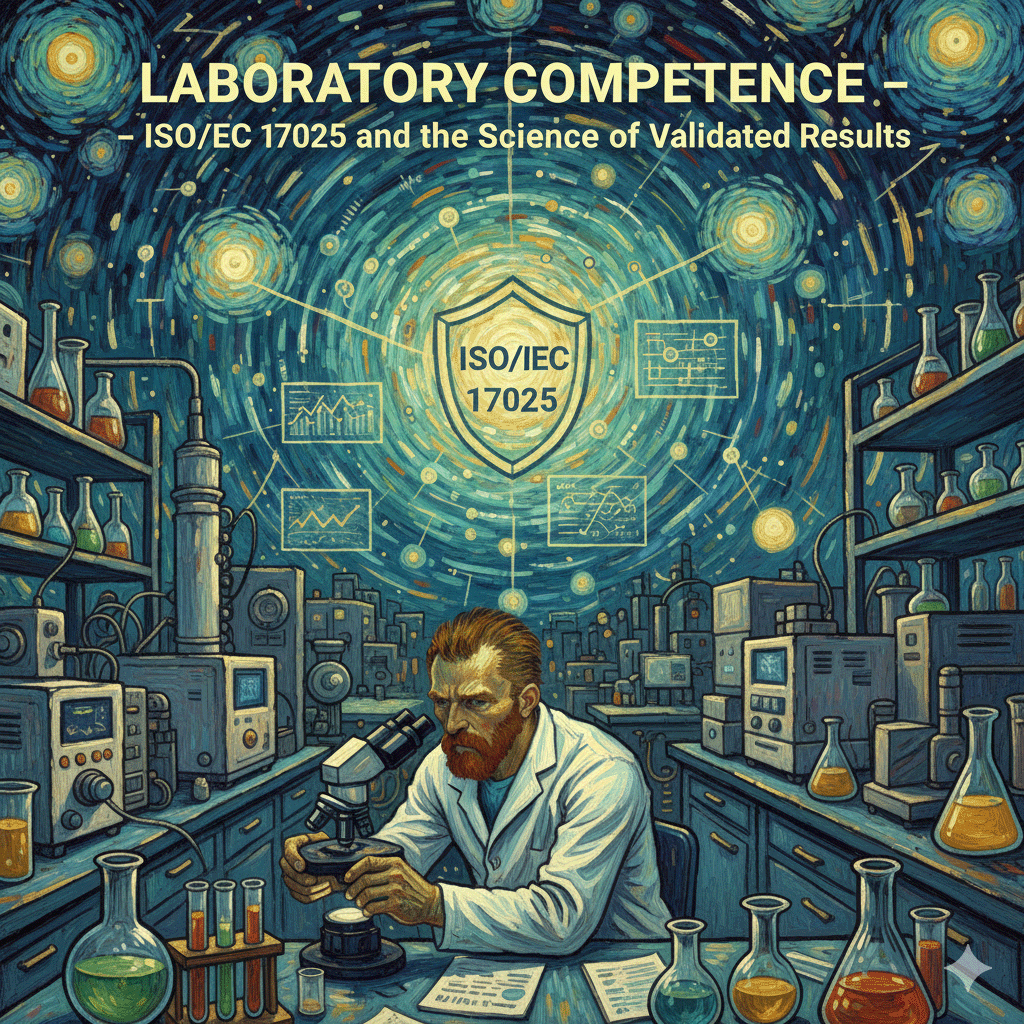
- Introduction: The Bedrock of Technical Trust
In the ecosystem of ISOSAF, if ISO 9001 is the “management foundation,” then ISO/IEC 17025 is the “technical heart.” While most ISO standards focus on management processes, ISO/IEC 17025 is specifically designed to assess the technical competence of testing and calibration laboratories. From a scientific perspective, it ensures that data generated in a lab is accurate, reliable, and reproducible. From a legal perspective, it ensures that test results are admissible in international courts and regulatory proceedings. Without the rigor of 17025, the “Observation” and “Assessment” pillars of any institute would lack the credibility required for global trade.
- The Legal Distinction: Certification vs. Accreditation
A common misconception in industry is that “certification” and “accreditation” are the same.
- Certification (ISO 9001): Confirms that a management system is in place.
- Accreditation (ISO/IEC 17025): Confirms that a lab is technically proficient to perform specific tests or calibrations. Legally, this distinction is vital. In many jurisdictions, if a product dispute arises regarding chemical contaminants or material failure, only results from an accredited laboratory carry the weight of “presumed accuracy” in a legal dispute.
- Structural Requirements and Impartiality
The 2017 version of the standard places immense emphasis on Impartiality and Confidentiality.
- Legal Shield: Laboratories must be structured to ensure that commercial, financial, or other pressures do not compromise technical judgment.
- Confidentiality: Legally, the lab must manage all information obtained during the performance of lab activities through a legally enforceable commitment. This is particularly critical for ISOSAF when handling proprietary pharmaceutical formulas or sensitive industrial data.
- Technical Requirements: The Science of Accuracy
The scientific core of ISO/IEC 17025 rests on several technical pillars:
- Metrological Traceability: Every measurement must be traceable to the International System of Units (SI) through an unbroken chain of calibrations. This ensures that a “gram” or a “degree” measured in Vietnam is identical to one measured in Germany.
- Validation of Methods: Labs cannot simply use a method; they must prove scientifically that the method is fit for its intended use. This involves determining the limit of detection (LOD), limit of quantification (LOQ), and linearity.
- Measurement Uncertainty (MU): Scientifically, no measurement is perfect. ISO/IEC 17025 requires labs to calculate the MU—the range within which the true value lies. Legally, if a product is near a regulatory limit, the MU can determine whether a product is “Pass” or “Fail.”
- Personnel Competence and the “Human Component”
Unlike general management standards, 17025 requires documented proof of the technical competence of the people performing the tests.
- Authorization: Personnel must be specifically authorized to operate particular equipment and perform specific tests based on their education, training, and demonstrated skill.
- Continuous Monitoring: Competence is not a one-time event; it must be monitored through “Blind Testing” or internal quality control samples.
- Ensuring Validity of Results: Proficiency Testing
How does a lab prove its results are correct to the outside world? Through Proficiency Testing (PT).
- The Process: An independent body sends a “blind” sample to multiple labs. The results are compared statistically (usually via a Z-score).
- Legal/Scientific Standing: A lab that consistently achieves a Z-score between -2 and 2 is considered technically competent. Failure in PT can lead to the legal suspension of a lab’s accreditation.
- Documentation and the “LIMS” Evolution
The standard requires a rigorous “Audit Trail” for every sample—from receipt and storage to analysis and disposal.
- Data Integrity: Modern labs utilize LIMS (Laboratory Information Management Systems) to ensure that data cannot be altered after the fact.
- The Legal Record: The “Test Report” or “Certificate of Analysis” (CoA) is the final legal product. ISO/IEC 17025 mandates exactly what information must be included to ensure the user can interpret the results correctly and that the results cannot be misused.
- ISOSAF’s Commitment to Laboratory Excellence
At ISOSAF, our Director of Science, Dr. Dmitri Volkov, oversees the integration of 17025 principles into our research and assessment workflows. By maintaining these standards, we provide our clients in the pharmaceutical, cosmetic, and food sectors with the “Technical Compass” they need. Whether it is verifying the purity of a raw material or measuring the safety of industrial waste, our results are backed by the global recognition of the ILAC MRA (International Laboratory Accreditation Cooperation Mutual Recognition Arrangement).
- Conclusion: The Language of Global Science
ISO/IEC 17025 is the “Universal Language” of science. It allows a lab in Singapore to trust the results of a lab in Vietnam. For any organization involved in “Frontier Development,” laboratory competence is the non-negotiable gatekeeper of innovation. It transforms raw data into “Validated Truth,” providing the legal and scientific certainty required to move products from the lab bench to the global market.
- References and Reliable Sources
- ISO/IEC (2017). ISO/IEC 17025:2017 General requirements for the competence of testing and calibration laboratories.
- International Laboratory Accreditation Cooperation (ILAC). ILAC P10:07/2020 ILAC Policy on Metrological Traceability of Measurement Results.
- Eurachem Guide. The Fitness for Purpose of Analytical Methods: A Laboratory Guide to Method Validation and Related Topics.
- JCGM 100:2008. Evaluation of measurement data — Guide to the expression of uncertainty in measurement (GUM).
- Czichos, H., Saito, T., & Smith, L. (2011). Springer Handbook of Metrology and Testing.
- ISOSAF Technical Bulletin. Navigating Measurement Uncertainty in Regulatory Compliance Testing.