- Introduction: The New Horizon of Observation
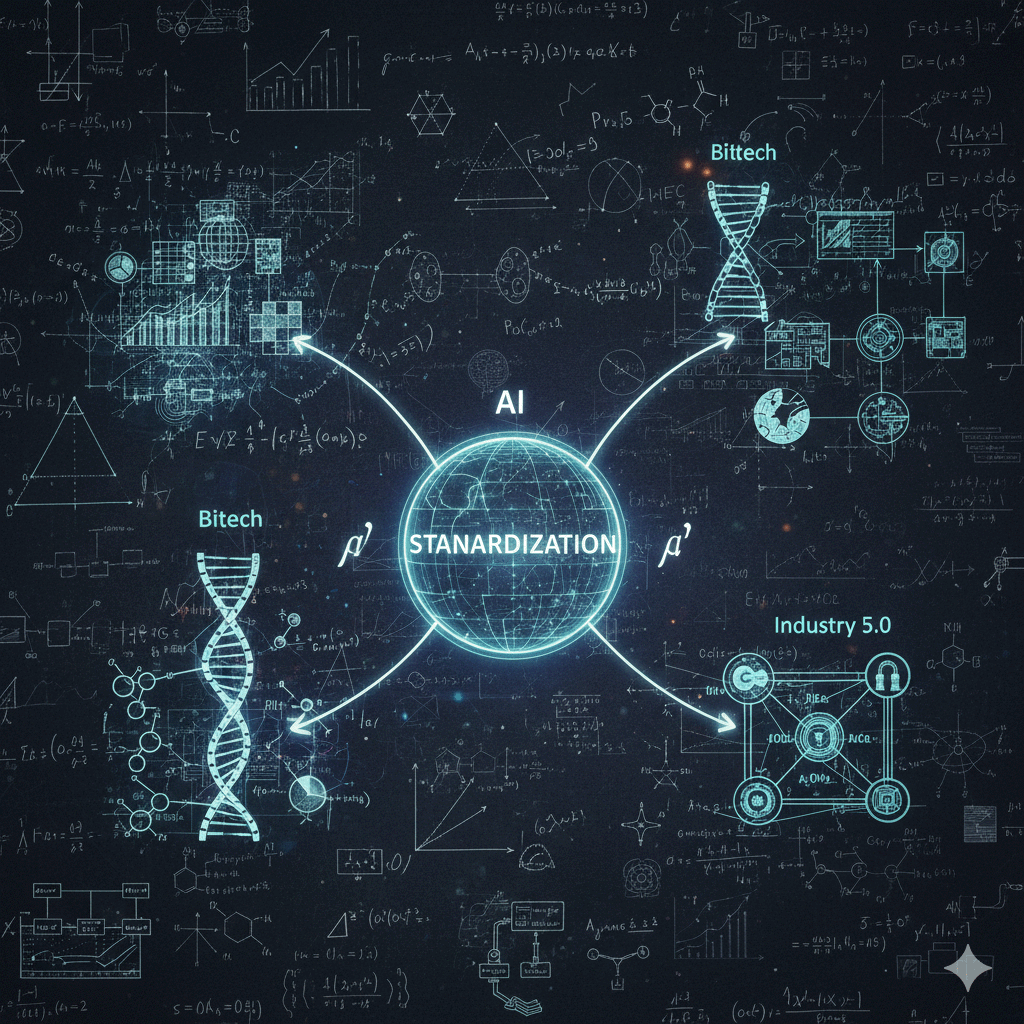
In the conceptual framework of ISOSAF, “Frontier Development” represents the final and most advanced pillar. As we transition into Industry 5.0, the focus of standardization is shifting from mere mass production and automation toward the harmonization of human creativity with high-tech systems. This new horizon encompasses Artificial Intelligence (AI), Synthetic Biology, and the Internet of Medical Things (IoMT). Standardization in these fields is no longer just about physical dimensions or chemical purity; it is about ethical algorithms, genomic data integrity, and the legalities of autonomous decision-making.
- Standardizing Artificial Intelligence: ISO/IEC 42001
AI is the “Observation” engine of the future, capable of analyzing vast datasets at speeds humans cannot match. However, without standards, AI poses significant legal and safety risks.
- The Legal Framework: The EU AI Act is the first comprehensive legal framework for AI, classifying systems based on risk (Unacceptable, High, Medium, Low).
- The Technical Solution: ISO/IEC 42001:2023 provides a management system for AI. It focuses on Explainability (can we understand why the AI made a decision?), Bias Mitigation (ensuring the AI doesn’t discriminate), and Robustness (ensuring the AI isn’t easily hacked).
- Application in ISOSAF: We use AI-standardized protocols to automate the “Assessment” of laboratory data, ensuring that “Standardization” is applied even to the software code itself.
- Biotechnology and Synthetic Biology: The Code of Life
Frontier development in biotechnology—such as CRISPR gene editing and mRNA technology—requires a new breed of scientific standards.
- Bio-Standardization: Standards like ISO 20387 (Biobanking) ensure that biological samples are stored and handled with scientific consistency.
- Legal and Ethical Boundaries: The Nagoya Protocol provides a legal framework for the fair and equitable sharing of benefits arising from the utilization of genetic resources. For a research institute like ISOSAF, compliance with these protocols is essential when exploring new frontiers in pharmaceutical development.
- Industry 5.0: The Human-Centric Shift
While Industry 4.0 was about “Smart Factories” and the IoT, Industry 5.0 focuses on the collaboration between humans and machines.
- Personalized Standards: In food and pharma, this means moving toward “Personalized Nutrition” or “Precision Medicine.” Standards must adapt to certify processes that create unique products for individual consumers rather than identical batches for millions.
- Scientific Resilience: Industry 5.0 emphasizes resilience—the ability of a system to withstand and adapt to global shocks (like pandemics or climate events).
- Cybersecurity and Data Sovereignty (ISO/IEC 27001)
In the digital frontier, data is the most valuable raw material.
- The Legal Pillar: Laws like the GDPR (EU) and the PDPA (Singapore/Vietnam) dictate how data must be handled.
- The Technical Pillar: ISO/IEC 27001 is the “Compass” for Information Security Management. As ISOSAF moves toward digital twinning and remote auditing, maintaining the highest level of cybersecurity is a non-negotiable standard to protect our clients’ intellectual property.
- The Precautionary Principle in Emerging Tech
As we explore the frontier, we often encounter technologies whose long-term impacts are unknown.
- Legal Application: The Precautionary Principle remains the primary legal tool. If a new biotech process or AI application has a potential risk of causing catastrophic harm, standards must be “Pre-emptive.”
- Scientific Rigor: This requires Horizon Scanning—a scientific method of searching for early signs of potential opportunities and threats.
- Frontier Assessment: Remote Auditing and Digital Twins
The “Assessment” pillar of ISOSAF is also evolving.
- Digital Twins: We can now create a digital replica of a pharmaceutical plant. Using ISO 23247, we can simulate production and identify quality failures in the virtual world before they happen in the real world.
- Remote Auditing (ISO 19011): Using AR/VR (Augmented/Virtual Reality), our experts like Klaus Schmidt can conduct high-precision technical audits of a facility in Da Nang or Guangzhou from our headquarters in Singapore.
- ISOSAF’s Vision for the Future
Under the leadership of Lukas Hoffmann, ISOSAF is positioned at the center of this transformation. Our mission is to ensure that as technology moves faster, the “Compass” of standards stays true. We believe that:
- Science must be Transparent: Open data and validated methods are the only ways to build public trust in AI and Biotech.
- Standards must be Agile: We move from rigid, decadal updates to dynamic, data-driven standardization.
- Frontier Development must be Ethical: Innovation is only “Progress” if it respects human rights and ecological limits.
- Conclusion: Beyond Limits
The journey through these 10 articles—from the foundational rigor of ISO 9001 and GMP to the ethical complexities of AI and Pharmaceutical Waste—demonstrates that Standardization is the engine of civilization. At ISOSAF (Institute of Science for Observation, Standardization, Assessment and Frontier Development), we do not just follow standards; we help define them. By combining the precision of German engineering, the strategic agility of Singaporean management, and the scientific depth of Russian analysis, we empower our partners to move “Beyond Certification, Beyond Limits.”
- References and Reliable Sources
- ISO/IEC (2023). ISO/IEC 42001:2023 Information technology — Artificial intelligence — Management system.
- European Parliament. The EU Artificial Intelligence Act (Regulation (EU) 2024/1689).
- ISO (2018). ISO 20387:2018 Biotechnology — Biobanking — General requirements for biobanking.
- United Nations. The Nagoya Protocol on Access to Genetic Resources and the Fair and Equitable Sharing of Benefits Arising from their Utilization.
- European Commission. Industry 5.0: Towards a sustainable, human-centric and resilient European industry.
- Schwab, K. (2016). The Fourth Industrial Revolution. World Economic Forum.
- ISOSAF Strategic Plan 2026. The Integration of Human Intelligence and Standardized AI in Global Auditing.